
Bats in Ohio: Which Ones Get Into Attics, and Why You Can't Evict Them in Summer
A bat flitting through the living room at dusk, a dark stain and a chittering sound at the soffit, or an ammonia smell building in the attic: that is usually how people discover they are sharing the house with bats. Ohio has eleven kinds of bat, a couple of them will roost in a building, and getting them out is more regulated and more time-sensitive than any other animal on this list. The single most important thing to know is that summer is often the wrong time to act.
The bats you'll find in an Ohio attic
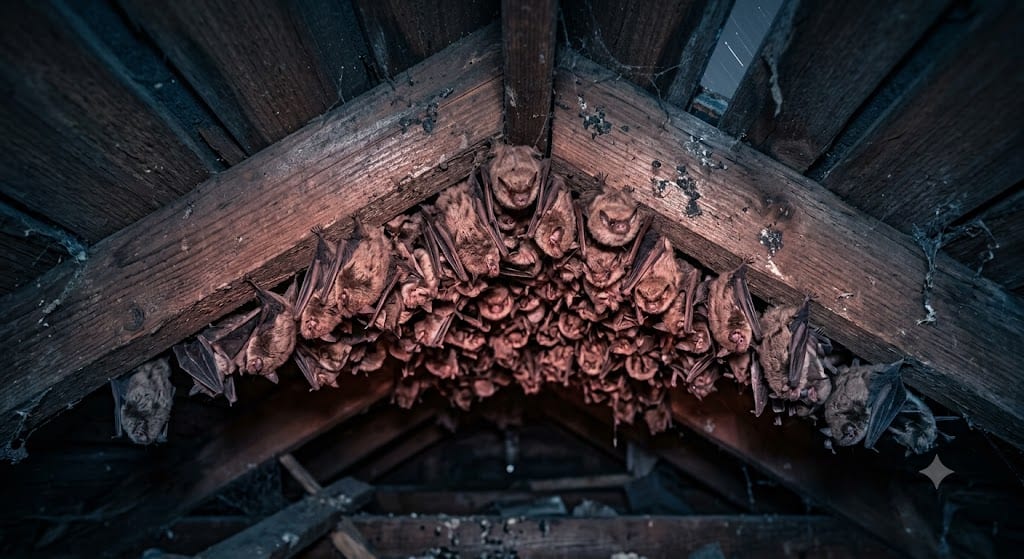
Of Ohio's eleven bat species, the two that regularly roost in houses are the big brown bat and the little brown bat. Both are small, plain brown, and able to squeeze through a gap smaller than you would believe to reach a warm attic, soffit, or gap behind the trim. They are also genuinely useful animals; a single little brown bat eats an enormous number of insects, mosquitoes included, in a night.
That usefulness, plus real trouble in the wild, is why bats are protected. Several of Ohio's species are endangered, including the Indiana bat and the northern long-eared bat, and a disease called white-nose syndrome has wiped out well over ninety percent of some populations. The upshot for a homeowner is simple: you cannot legally just kill the bats in your attic, and you would not want to even if you could.
Why they're up there: maternity colonies
Bats pick an attic for the same reason everything else does, it is warm and safe, but in summer there is usually more to it. A summer roost is often a maternity colony: adult females gathered to raise their young. The pups are born in late May and early June and cannot fly until around the middle of July, when they are about five weeks old. That detail is the whole ballgame when it comes to timing.
Why you can't just evict them in summer
Ohio law allows exactly one method of bat removal, and that is exclusion, meaning one-way devices that let bats leave a building and not get back in. The catch is the calendar. From May 16th through July 31st, if five or more bats are present, you may only exclude them after getting written permission from the Ohio Division of Wildlife, because that is the maternity window. Seal the adults out while the pups still cannot fly and you trap those pups inside to die, which is both inhumane and illegal, and leaves you with dead animals decomposing in the wall.
The windows the state points to for straightforward exclusion are April 1st through May 15th, before the pups arrive, and August 1st through October 15th, after they can fly. So a bat problem discovered in June or July frequently means the right move is to confirm what you have, keep the bats out of your living space, and schedule the actual exclusion for the legal window rather than rushing it.
The health side: rabies and guano
Two health issues make a bat in the house different from a bat in the yard. The first is rabies. Bats are the leading source of human rabies deaths in the United States, and a bat bite can be so small you do not feel it, so a bat found in a room with a sleeping person, a child, or a pet is treated as a possible exposure. Do not release that bat, do not handle it bare-handed, and call your local health department, because it may need to be tested.
The second is the guano. The droppings that pile up under a roost can grow a fungus that causes histoplasmosis, a lung infection you get by breathing in spores when the guano is disturbed. That is why cleaning out an attic roost is a job for someone with the right protective equipment and not a shop vacuum on a Saturday afternoon.
How bat removal actually works
Done correctly, bat removal is exclusion, not extermination. The process is to inspect the house and find every gap the bats are using, install one-way devices so the bats leave on their own and cannot return, do it inside the legal window, then seal the openings for good and clean up the guano safely. It is exacting work, it is tied to the calendar, and it has legal strings attached, which is exactly why professional bat removal is worth it here more than almost anywhere else: a licensed operator knows the timing and the rules and does the exclusion so the bats leave and stay gone.
When to call
A bat in your living space, staining and squeaking or a smell at the soffit or attic, or bats you can watch peeling out from the roofline at dusk are all reasons to bring someone in. If a bat turns up in a bedroom, treat it as a health question first: keep it contained rather than letting it go, and call your health department. Then call us. Caudill Pest Control is local to central Ohio and does bat work the legal way, on the right timeline, so it holds.