
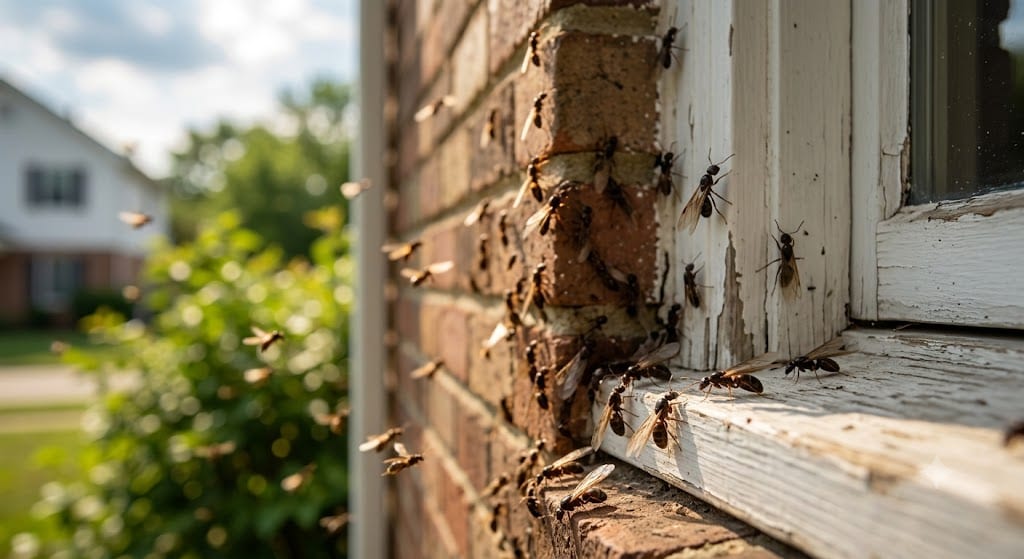
Flying Ants in Ohio: Do They Bite, Why They Swarm, and How to Get Rid of Them
You walked into the kitchen and the window was crawling with winged insects, or a cloud of them boiled up out of a crack in the driveway on a muggy afternoon. If you're seeing flying ants around your central Ohio home, the first thing to know is that you're almost certainly not in any danger. The second thing to know is that a swarm is a signal, and it's worth reading what it's telling you.
Here's what those flying ants are, whether they bite, how to be sure they aren't termites, and when a swarm means there's a colony you actually need to deal with.
What flying ants actually are
Flying ants aren't a separate kind of ant. They're the reproductive members of an ordinary ant colony, the winged males and young queens that entomologists call swarmers. Once a colony is mature and well established, it produces these winged ants and sends them out together on a warm day to mate and start colonies of their own.
That's why they show up in a burst and then seem to vanish. After the flight the males die within a day or two. The mated queens drop to the ground, break off their own wings, and go looking for a place to start over. The wings you find on a windowsill are theirs.
The practical takeaway: a swarm means there is a well-established nest nearby. A young colony doesn't produce swarmers, so the winged ants aren't really the problem in themselves. They're evidence that a colony has been around long enough to reproduce, and that it's close.
Do flying ants bite or sting?
This is the question we hear most, so let's answer it plainly: flying ants around an Ohio home are very unlikely to hurt you. Swarmers are focused on mating, not on defending a nest, so they aren't aggressive. Ohio doesn't have established fire ants, and most of the ants that get into Ohio homes don't sting at all.
The one exception worth naming is the carpenter ant, the big black ants you'll sometimes see with wings in spring. If you handle one it can bite readily with its jaws, and it can make that bite sting by injecting a little formic acid into it. Even so, it isn't venomous and it isn't a health threat. The reason to care about carpenter ants is the wood they nest in, not their bite.
Flying ants vs. termite swarmers: how to tell the difference
This is the one distinction that genuinely matters, because termite swarmers look a lot like flying ants at a glance and they mean something very different for your house. Get close (a phone photo zoomed in works well) and check three things.
- Waist: an ant has a narrow, pinched-in waist. A termite has no waist. Its body is a straight, broad tube from front to back.
- Wings: an ant's two pairs of wings are different lengths, with the front pair clearly longer. A termite's four wings are all the same length and much longer than its body, and they break off easily, so a little pile of identical shed wings points to termites.
- Antennae: an ant's antennae are bent, like a tiny elbow. A termite's are straight and look like a small string of beads.
Why it's worth thirty seconds: termite swarmers mean a termite colony, and termites eat the structural wood in your home. Eastern subterranean termites do live in Ohio. They put more pressure on homes farther south than they do here, but they are real and they have been found in central Ohio. If your three checks point to termites, don't wait. Get a dedicated termite inspection from a company that treats them. That is a different job than general pest control, and it's the one time a swarm is a true emergency.
Why you're seeing them now
Ant swarms are triggered by weather. In Ohio you'll typically see them on warm, humid days from late spring through summer, very often in the day or two after a rain when the air is heavy. Colonies across a whole neighborhood will often swarm on the same day, which is why it can feel like the sky filled with flying ants all at once.
Indoors, swarmers head for the light: windows, sliding doors, light fixtures. And this is where the location tells you something important. Ants that show up outside, or that you find trying to get out at the outside of a window, are usually from a colony in the yard, a nuisance that passes in a day. Ants coming out from behind a baseboard, from inside a wall, or over and over inside the house are a different story. That points to a nest inside your structure.
What to do about them
For a one-time swarm at the windows, the fix is simple and you don't need anyone's help. Run a vacuum over them, empty it outside, and wait it out. Knocking down the fliers you can see is fine for your peace of mind.
What it won't do is solve anything, and this is the part people get wrong. Spraying the swarmers, or worse, emptying a can of store spray at the trail, kills the ants you can see and leaves the colony untouched. The swarmers were on their way out to die or to leave anyway. The queen and the nest are somewhere you're not spraying, and a colony that gets disturbed can simply move and come back worse.
A few things that actually help, and that you can do yourself:
- Cut off the water. Ants want moisture, and carpenter ants especially are drawn to damp wood. Fix the dripping hose bib, the leaky trap under the sink, the gutter that dumps against the foundation.
- Close the doors. Seal the gaps around windows, utility lines, and the foundation sill wherever you can reach them.
- Trim the bridges. Branches and shrubs touching the house are highways. Give the siding a few inches of clearance.
Where a homeowner's own efforts run out is with an established or indoor colony. If you're finding winged ants inside more than once, if you're seeing big black carpenter ants along with a little pile of what looks like sawdust (that's frass, the wood they've dug out), or if the same swarm turns up in the same spot every year, there is a colony living in or against your home, and it needs to be found and treated at the source. That means following the workers back to the nest and treating it, not chasing the swarmers around. That's where we earn our keep. Professional ant control tracks the colony down and deals with the nest, so the problem stops instead of moving.
Caudill Pest Control is local to central Ohio, and flying-ant season is one of the most common reasons our neighbors call. If a swarm has you wondering whether there's a colony in the walls, we can take a look and tell you straight.