
German vs. American Cockroaches in Ohio: How to Tell Which One You Have
Almost nobody stays calm the first time a cockroach runs across the kitchen floor. But once the initial reaction passes, the single most useful thing you can do is figure out which cockroach it was. The two you're most likely to meet in an Ohio home are the German and the American cockroach, and they are not the same problem. One is a breeding infestation. The other is usually a visitor from a drain. Telling them apart tells you what you're actually dealing with.
The two you're most likely to see in Ohio
A quick look at size and color sorts out most sightings.
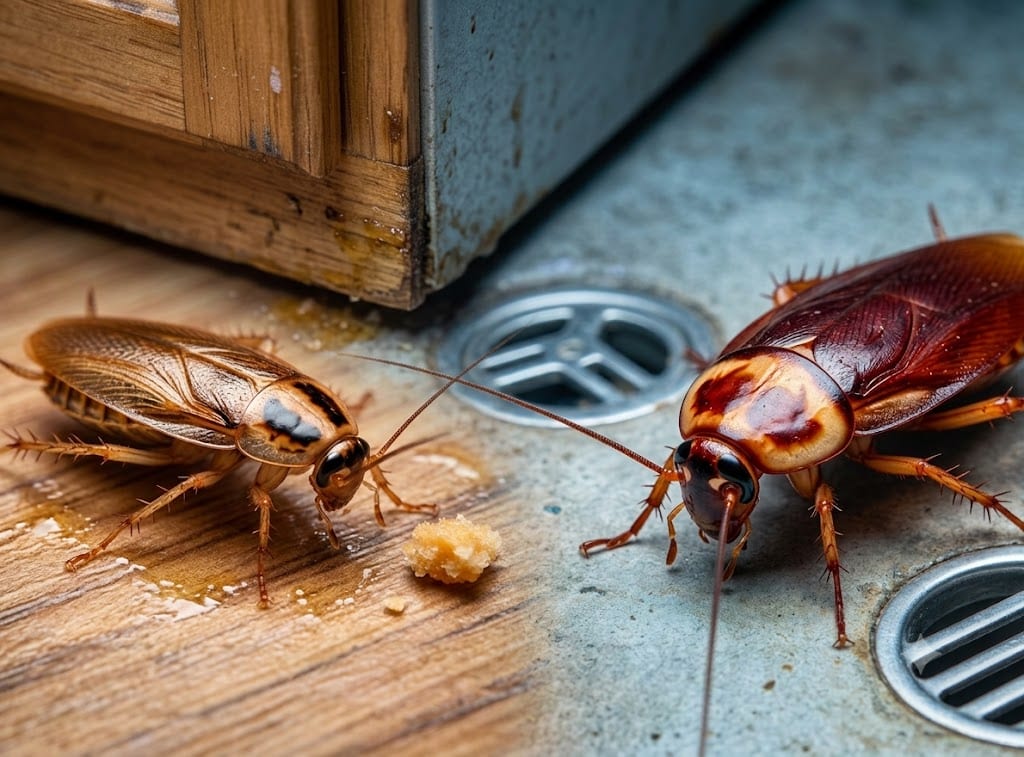
- German cockroach: small, about half an inch long, tan to light brown, with two dark parallel stripes running back from the head. It likes warm, humid rooms close to food and water, which means kitchens and bathrooms. This is the one that breeds indoors and the most common indoor cockroach in the country.
- American cockroach: big, up to about an inch and a half, reddish-brown with a pale yellowish band around the shield behind its head. Despite the name it is not the usual indoor breeder. It lives in basements, floor drains, sewers, and steam tunnels, and comes up into living space from there. Plenty of people call this one a water bug.
Two others turn up here and are worth naming so you don't mistake them. Oriental cockroaches are dark, almost black, and hang around damp basements, drains, and crawlspaces. Wood cockroaches are the harmless ones: they live outdoors, wander in during spring, are drawn to lights, and do not infest a house. A big roach out by the firewood pile is almost always a wood cockroach, not an invasion.
Why the difference matters
A German cockroach in the kitchen means a colony is breeding inside your home. They tuck into cracks near the stove, the dishwasher, and the sink and reproduce continuously. Seeing even a few of them out in daylight usually means a lot more are hidden nearby, because they only come into the open when the harborage is crowded. This is the serious one, and it rarely fixes itself.
An American cockroach is more often a smaller number that came up from a drain, a sump, or a sewer connection, or wandered in from a damp basement. It is startling because of the size, but it is usually a moisture-and-entry problem rather than a kitchen breeding one. The fix leans on drying things out and sealing the way in, though steady numbers still call for treatment.
The health reason not to live with them
Cockroaches are not just unpleasant to look at. Their droppings, shed skins, saliva, and body parts contain allergens, and those allergens set off rashes, watery eyes, sneezing, congestion, and asthma. Public-health agencies rank cockroach allergen as one of the strongest asthma triggers in indoor environments, and children are the most affected. If someone in the house has asthma, a roach problem is a genuine air-quality issue, not just a nuisance.
How to tell they are breeding
The tell is the egg case, a small capsule the entomologists call an ootheca. A German female carries her light brown, purse-shaped case, packed with two rows of eggs, until it is almost ready to hatch, so if you are seeing German cockroaches you are almost certainly looking at a population that is reproducing right where they live. An American female drops her darker, slightly larger case near a food source. Finding these capsules tucked in a cabinet corner or behind the fridge means the problem is established, not a one-time stray.
Why the store spray disappoints
Here is the part that frustrates people. German cockroaches have been outrunning insecticides since the 1950s, and resistance to common over-the-counter products is widespread. A can of spray kills the few roaches you see, scatters the rest deeper into the walls, and can actually wreck the one approach that works. Real control comes from baits placed precisely where the roaches travel and shelter, and spraying over those bait spots can repel the roaches from the bait instead of drawing them to it. Done properly it is a job of finding the harborage, baiting it correctly, and following up as the population crashes. That is where professional cockroach control earns its keep.
None of that means you are helpless in the meantime. Fixing moisture, cleaning up food and grease, taking out the trash, and sealing cracks all make your home less livable for roaches. With German cockroaches, though, good housekeeping slows them down; it rarely clears an established infestation on its own.
What pulls cockroaches in
Cockroaches need three things, and every one of them is something you can take away. They need water, which is why a dripping trap, a sweating pipe, or a damp basement is an open invitation. They need food, and to a roach that includes the grease film on the stove, the crumbs under the toaster, the pet food left down overnight, and the trash that didn't go out. And they need tight, dark places to shelter, which is exactly what stacks of cardboard, cluttered cabinets, and the gaps around pipes and baseboards give them.
Take those away and the house turns genuinely inhospitable. Fix the leaks, wipe down grease, keep food and pet food sealed, break down and recycle the cardboard, and seal the gaps where pipes and wires come through the wall. American cockroaches in particular ride in through floor drains and sewer connections, so a drain cover and a little maintenance on the drains you rarely use closes a common door. None of this replaces treatment once a German infestation is established, but it removes the conditions that let one take hold to begin with.
When to call
A few German cockroaches in the kitchen, roaches out in the daylight, egg cases behind the appliances, or American roaches that keep coming up from a drain after you have sealed and dried what you can reach, are all signs it is time to bring someone in. Caudill Pest Control is local to central Ohio. If you are not sure which roach you have, send us a photo and we will tell you what you are dealing with and what it takes to be rid of it.