
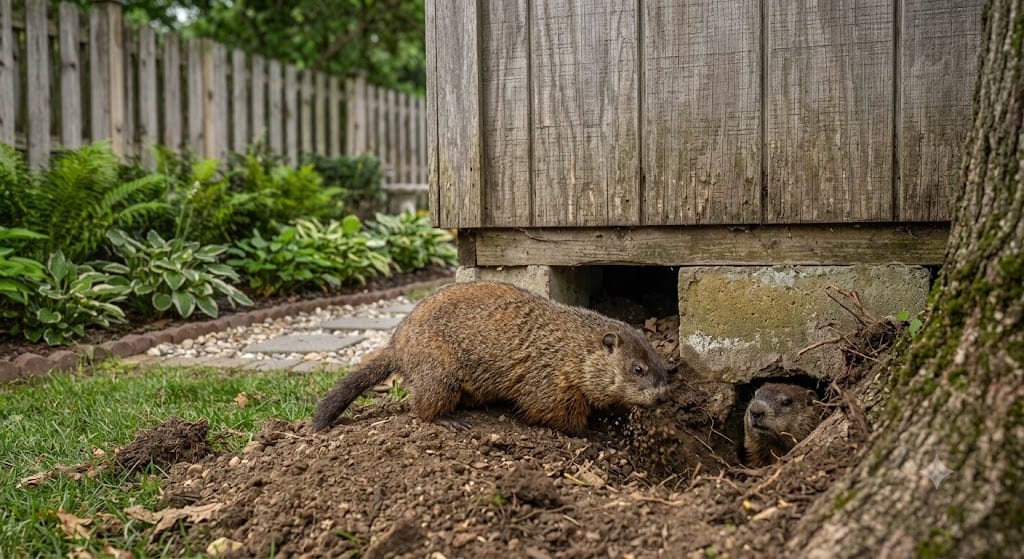
Groundhogs in Ohio: The Burrow Under Your Shed Is the Real Problem
A fresh mound of dirt beside a big hole near the shed, a vegetable garden that got mowed down overnight, or a fat brown animal sunning itself on the edge of the deck: that is a groundhog announcing that it has moved in. They live in all eighty-eight Ohio counties, and while the eaten garden gets the attention, the part that actually matters is the burrow.
What a groundhog actually is
A groundhog and a woodchuck are the same animal, and it is a rodent, the largest member of the squirrel family. A grown one runs roughly five to thirteen pounds, is brown and low-slung, and is built for digging. Groundhogs are true hibernators: they go underground around late October or November and stay down until late February or March, which is where the whole Groundhog Day tradition comes from. They raise one litter a year, born in spring, so by early summer you may be dealing with a family rather than a single animal.
The burrow is the real problem
A groundhog does not just dig a hole, it digs a system. A typical burrow has two or three entrances connected by tunnels that can run five feet deep and anywhere from eight to sixty feet long. Out in a field that is the farmer's problem. Next to your house it is yours, because when that tunnel network runs under a shed, deck, porch, patio, or the corner of a foundation, it undermines the ground the structure is sitting on. Slabs crack, steps settle, and concrete shifts over the void a groundhog has hollowed out. That is why a burrow against a building is worth dealing with promptly, not next season.
And yes, the garden
The other half of a groundhog is its appetite. It is a heavy-duty vegetarian that will work through soybeans, peas, beans, clover, and most of a vegetable garden, and a single groundhog can flatten a season's worth of growing in short order. It is maddening, but it is survivable in a way a compromised foundation is not, which is why the burrow stays the headline.
Getting rid of one
Removal starts with trapping, but it does not end there. A live trap works best set right at the active burrow entrance or on the groundhog's travel path, funneled and concealed so the animal walks in. The catch is figuring out which hole is actually active, since a groundhog often keeps more than one entrance and will dig spares. Ohio also has real rules here: if you trap the animal yourself you are responsible for it, the trap has to be labeled with your name and address and checked every twenty-four hours, and cities frequently have their own ordinances on top of that.
The step people skip is the burrow itself. Removing the groundhog and leaving an open tunnel system just hands a finished home to the next one that wanders by, so the den has to be closed off and the area excluded, usually by burying fencing with the bottom bent outward so a groundhog cannot dig back under it. Between the structural stakes, the active-hole guesswork, and the rules, this is where professional groundhog trapping earns its keep: the animal comes out, the burrow gets closed, and the spot stops being an open invitation.
How to know it is a groundhog
A groundhog hole is bigger than people expect, usually ten to twelve inches across, with a conspicuous mound of excavated dirt fanned out beside the main entrance. The other entrances tend to be cleaner and harder to spot, tucked into tall grass, a fencerow, or the shadow under a deck, because the animal kicks the dirt out the front door. If you see that big front hole with its dirt pile within a few feet of a structure, and a low brown animal that waddles more than it scurries, you have a groundhog rather than something smaller like a chipmunk or a rat.
Making your yard less appealing
Groundhogs like cover right next to open feeding ground, so brush piles, stacked lumber, rock piles, and an old woodpile leaned against the shed give them exactly the protected launch point they want. Clearing that out helps. So does closing off the open space under decks, sheds, and porches with fencing buried about a foot down and bent outward at the bottom, which is the one barrier a digging animal has real trouble beating. And when an old burrow turns up, filling it in promptly keeps it from being reused. None of that evicts a groundhog already dug in, but it makes your yard a less obvious place to start.
When to call
A large hole with a mound of fresh dirt next to a shed, deck, porch, or foundation, a garden that keeps getting eaten to the ground, or a groundhog you keep seeing on the same path are all reasons to bring someone in, and the sooner the better if the burrow is against a structure. Caudill Pest Control is local to central Ohio and handles wildlife, groundhogs included. If something has dug in next to the house, give us a call before the tunnel does any more work.