
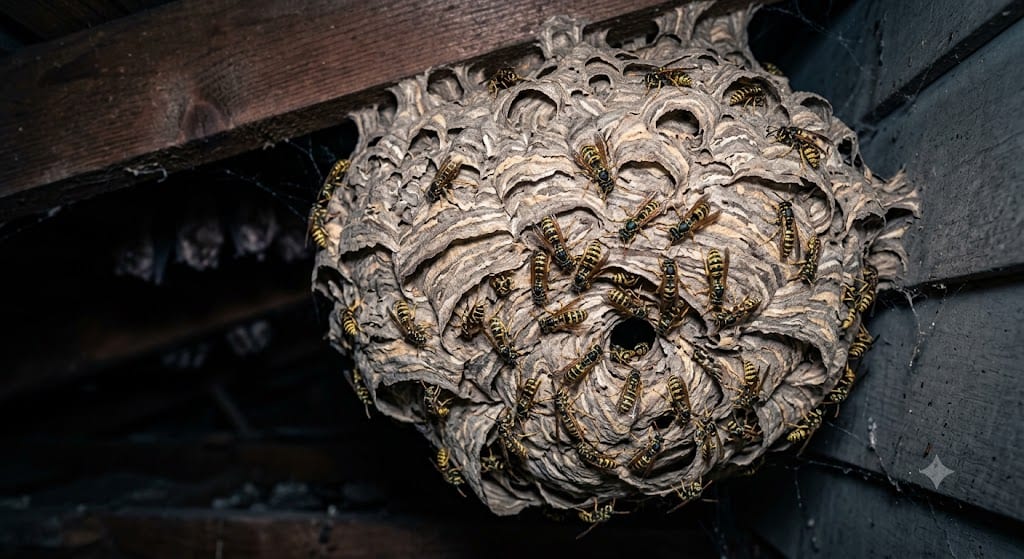
How to Get Rid of a Bees Nest in Ohio (It's Usually Yellow Jackets)
Somewhere near the top of the list of pest questions people type into their phone is how to get rid of a bees nest, and it usually comes with a twist the searcher does not expect: the thing they are calling a bees nest is very often not bees at all. It is yellow jackets. That matters, because bees and yellow jackets call for completely different responses, right down to who you should phone.
First, is it actually bees?
The quickest way to sort this out is to look at the insect and at where the nest is. A honey bee is fuzzy, a bit chunky, and carries little balls of pollen on its back legs, and it builds waxy combs, usually inside a wall cavity or a hollow tree. A honey bee never nests in the ground, and each worker can only sting once before it dies, so away from the hive they are fairly calm.
A yellow jacket is the opposite: shiny and smooth rather than fuzzy, with a narrow waist and sharp yellow-and-black bands. Most yellow jackets nest in the ground, in an old animal burrow or a cavity, though they will also build their papery nests inside wall voids and other protected spaces. And unlike a honey bee, a yellow jacket can sting again and again, and it will, especially near the nest. So if the nest is a hole in the lawn with insects streaming in and out, or a papery mass in a wall or eave, and the insects are shiny and quick to anger, you are looking at yellow jackets, not bees.
If it really is honey bees, don't kill them
On the chance it genuinely is honey bees, with real wax comb and calm, fuzzy, pollen-carrying workers, the right move is not a can of spray. Honey bees are valuable pollinators, and the recommendation from the experts is to relocate them rather than exterminate them. A beekeeper, or a pest company that works with one, can often remove an entire colony and rehome it in a proper hive. Beekeepers who do this kind of structural removal are not on every corner, since it takes both beekeeping and a bit of construction skill, but your county or state beekeepers' association can usually point you to one.
The nests people actually want gone
When someone urgently wants a nest gone, it is almost always one of these, and all of them are wasps rather than bees.
- Yellow jackets: the shiny, aggressive ones that nest in the ground or in wall voids. A single colony can grow into the thousands by late summer, and they defend the nest hard.
- Paper wasps: the makers of the open, upside-down umbrella nests you see under eaves, in soffits, and inside grill covers. Less aggressive, but the nest is right where people reach.
- Bald-faced hornets: the builders of the big gray football-shaped paper nest hanging in a tree or on the side of a house. Despite the name it is actually a type of yellow jacket, and it is one of the more defensive ones.
- European hornets: Ohio's only true hornet, large and reddish-brown, sometimes noticed at night because they are drawn to lights.
Why late summer is the worst of it
A yellow jacket problem almost always peaks from August into October. That is when the colony is at full strength, often thousands of workers, and it is also when the yellow jackets switch from hunting insects to craving sweets, which is exactly why they crash the cookout and hover around the trash can and the soda. A nest that was small and easy to overlook in June is at its biggest and most defensive by September.
Why getting rid of the nest yourself is risky
These insects sting repeatedly and swarm to defend the nest, and a few specific do-it-yourself mistakes reliably make things worse:
- Never plug the opening of a nest in a wall. Trapped yellow jackets will chew straight through the interior drywall and come out inside the house instead.
- Never try to burn or flood a nest. It does not work and it turns a nest full of stinging insects furious.
- A can of store spray often cannot reach a nest deep in a wall or underground, and standing over the entrance spraying is exactly where people get swarmed.
There is also the health side. Repeated stings are painful for anyone, and for a person who is allergic even a single sting can be a medical emergency. Between the sting risk, the reachability of a nest inside a wall or in the ground, and the wall-chewing trap, a real nest is a job for professional yellow jacket control, which treats the nest at the source and removes it without turning your wall into an escape hatch.
When to call
A papery nest in a wall, soffit, or eave, insects pouring out of a hole in the lawn or a gap in the siding, a gray football-shaped nest in a tree near the house, or any nest close to a door, a walkway, or someone with a sting allergy are all reasons to bring someone in rather than improvise. Caudill Pest Control is local to central Ohio. If it turns out to be honey bees, we will tell you and point you toward a beekeeper. If it is yellow jackets, wasps, or hornets, that is exactly what we handle.