
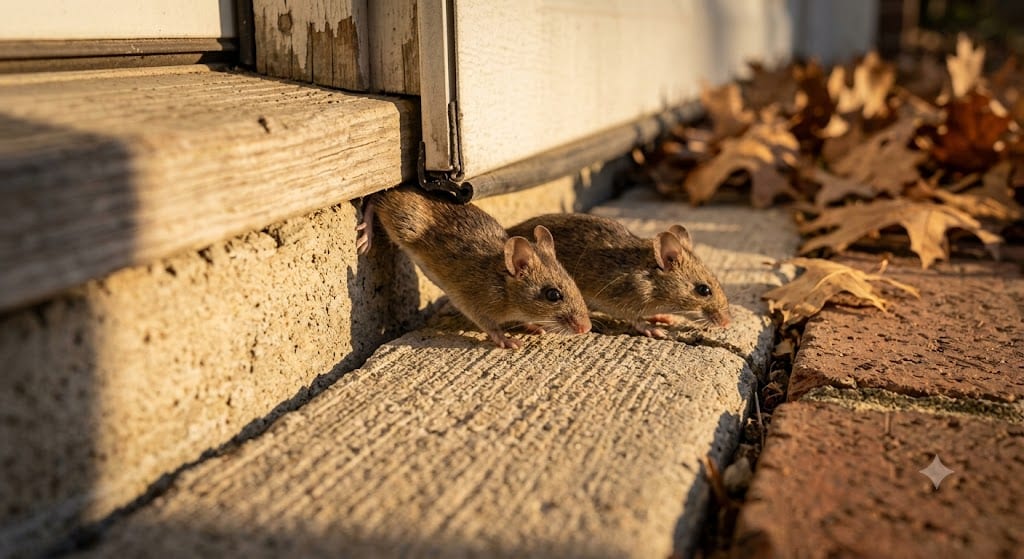
Mice in the Walls: How to Tell, Why It Starts Every Fall, and How to Get Rid of Them for Good
The sound is unmistakable once you know it: light scratching or scurrying inside a wall or above the ceiling, always after dark, always in the same stretch of wall. By the time most Knox County homeowners hear it, the mice have been in the house for a while. This post covers how to be sure it is mice, why it happens in the fall, and why the fix is sealing the house rather than just setting traps.
Is it really mice?
House mice are small: about 5 1/2 to 7 1/2 inches long including a 3 to 4 inch tail, and they weigh only about half an ounce to an ounce. The signs they leave are consistent.
- Droppings. Dark pellets 1/8 to 1/4 inch long, with one or both ends narrowing to a point. A single mouse drops roughly 50 to 75 of them a day, so even a small problem shows up fast under the sink, in the pantry and along baseboards.
- Gnaw marks. Fresh marks are about 1/32 inch wide, on packaging, wood, and sometimes wiring.
- Nests. Finely shredded paper or other soft, fibrous material tucked into a cabinet, a storage box, a wall void or attic insulation.
- Sounds. Scratching and squeaking at night, when mice are most active.
- Odor. A musky smell in enclosed spaces like a pantry, basement or behind an appliance.
If you are seeing larger droppings and hearing heavier movement in a basement or crawl space, it may be rats, and the approach changes. Our rodent control page explains how we tell the two apart on inspection.
Why it starts in the fall
Mice can live outdoors through the summer. When the nights turn cold, a heated house with food in it is a better deal, and a mouse can squeeze through an opening only slightly larger than 1/4 inch. The gap under a garage door, the space around a pipe or cable where it enters the wall, a torn foundation vent screen, or a crack at the corner of the siding is all the invitation they need. That is why the calls to Caudill jump with the first cold snaps every year in Centerburg and Mount Vernon.
Once in, a mouse does not need much. An adult eats about 1/10 of an ounce of food a day and can get by with no water at all beyond what is in its food. They also do not travel far: mice seldom range more than 50 feet from their nest and food, which is why the activity stays in one part of the house.
Why a few mice become an infestation
The numbers are the reason to act early. A female can raise 5 to 10 litters a year of 5 to 6 young each. The young are born 18 to 21 days after mating and are ready to breed themselves in 6 to 10 weeks. Two mice that got in during the first cold week of October can have a litter born and nearly grown before Thanksgiving.
Why it matters beyond the noise
Mice contaminate food and surfaces as they travel, and the University of Nebraska-Lincoln's extension guide lists salmonellosis among the diseases they can transmit. Mouse urine has also been implicated as a trigger for asthma. Gnawing on wiring is a separate and real concern.
Why traps alone rarely end it
Traps work, and they are part of every removal. But traps only remove the mice that are already inside. If the 1/4 inch gap is still open, the next mouse walks in behind them, and the cycle repeats every fall. That is why our rodent control service is built in three parts: an inspection that traces the droppings, rub marks and gnaw marks back to the actual entry points, trapping and baiting placed on the runways mice are actually using, and exclusion work that seals those entry points so they cannot return.
A few details on why the sealing has to be done right. Mice chew through soft materials, so latex, plastic, rubber and thin boards do not hold. The materials that work are copper woven-wire mesh or stainless steel fiber products packed into the gap and locked in with sealant or mortar. Around doors that means proper sweeps, and around the foundation it means the same mesh packed into every opening a mouse could use.
What you can do today
- Store pantry food, pet food and bird seed in sealed containers.
- Clear clutter from the garage, basement and storage areas so nests have fewer places to hide.
- Walk the outside of the house at dusk and look for gaps around pipes, cables, vents and the garage door, anything a pencil could fit through.
- If you set your own traps, place them along walls where you have seen droppings, no more than about 10 feet apart. Nebraska's guide notes that two dozen properly placed snap traps will control a new infestation in a 1,500 square foot house.
Our earlier post on how to keep mice out of your house this fall walks through the exclusion checklist room by room.
Frequently asked questions
Will mice in the walls go away on their own?
Usually not. Once they have shelter and a food source they stay and multiply, especially through the cold months.
How do I know if the mice are gone?
No new droppings, no fresh gnaw marks and no nighttime sounds for a couple of weeks after trapping. A follow-up inspection confirms the sealed entry points are holding, which is the part that keeps them gone.
Is it mice or rats?
Mice are smaller, leave the small pointed droppings described above, and can use much smaller openings. Rats are larger and noisier, leave bigger droppings, and are more often found in basements, crawl spaces or burrows near the foundation. The inspection settles it.