
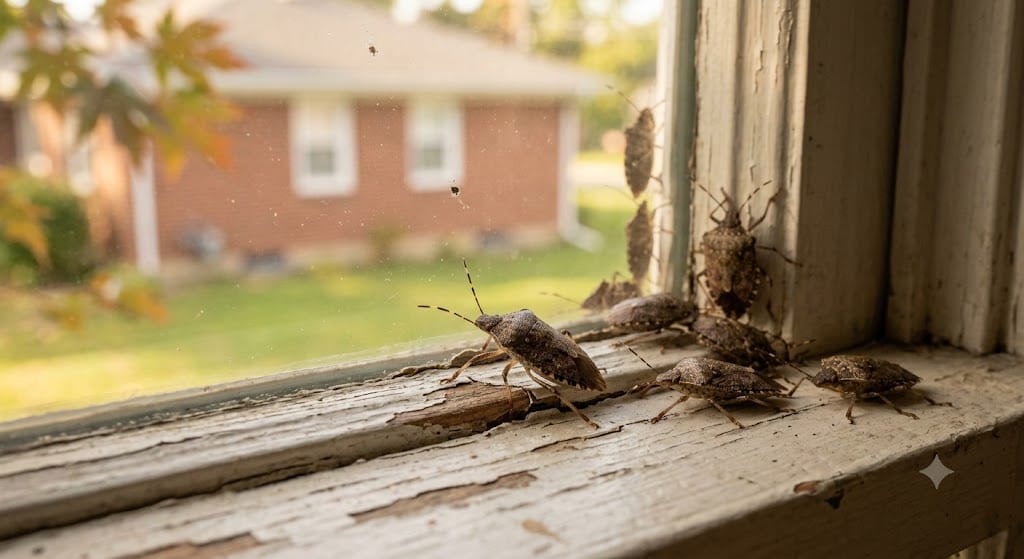
Stink Bug, Asian Beetle, Boxelder Bug or Cluster Fly? How to Tell Ohio's Fall Invaders Apart
Every fall in Knox County the same four bugs show up on the same walls, and people call them all "stink bugs" or all "ladybugs." They are four different insects with different habits, and knowing which one you have tells you what to expect and what to do. The good news is that they arrive the same way, so one prevention plan covers all of them.
What they have in common
All four are looking for a protected place to spend the winter. None of them breed inside a house, none of them damage the structure, and none of them are there because of food or dirt. They land on the warm, sunny side of a building on a mild fall day, work into cracks around windows, siding, soffits and vents, and settle into wall voids and attics. Some follow the heat into living space by accident, which is why you see them on windowsills through the winter.
Brown marmorated stink bug
Look for: a shield-shaped bug about 5/8 inch long and 3/8 inch wide, roughly the size of a thumbnail, mottled brown and gray on top and white underneath. The giveaway is the alternating light and dark bands on the last two segments of the antennae and along the edges of the body.
When: peak flight to buildings is late September or early October.
Background: an introduced species, first documented in Ohio in December 2007 in Franklin County. Ohio State University Extension's fact sheet records it in 62 of Ohio's 88 counties and says it can likely be found in all of them.
Harm: none to people or the house. They do not bite. Disturbed or crushed, they release the pungent odor they are named for.
Read next: How to get rid of stink bugs in your Ohio home.
Multicolored Asian lady beetle
Look for: a domed, round beetle 0.2 to 0.3 inches long, yellow to orange to red, with anywhere from no spots to 19 black ones. The tell is a black M or W shaped mark on the white section behind the head.
When: the first day over 64 degrees after a significant temperature drop, usually mid to late October in Ohio.
Harm: this is the one that bites, though it cannot break the skin. Crushed or disturbed, it releases a yellow-orange fluid that stains walls and fabric permanently and smells foul.
Read next: Asian beetles in your house this fall.
Boxelder bug
Look for: a slim, flat-backed bug 1/2 to 3/4 inch long, dark gray to black, with three orange-red stripes behind the head.
When: they mass on the sunny side of trees and buildings during the first cold snaps of early fall, then scatter for shelter when a warm spell follows.
Harm: a nuisance only. The fluid inside them stains, and a crushed bug releases a foul defensive chemical. They come from boxelder, maple and ash trees nearby.
Read next: Boxelder bugs in Ohio.
Cluster fly
Look for: a large, dark fly that looks like a house fly but moves slowly and bumps into things. They gather in numbers at one window or in one room.
When: the earliest arrival. The last summer generation moves to buildings in mid to late September.
Harm: none. They do not bite, do not breed indoors, and did not come from anything dead. They develop outdoors as parasites of earthworms.
Read next: Cluster flies in the house all of a sudden.
Quick identification
- Shield shape, banded antennae, thumbnail sized: stink bug.
- Round, domed, orange, M mark behind the head: Asian lady beetle.
- Slim, black, three red stripes: boxelder bug.
- Looks like a fly but slow and clumsy: cluster fly.
One plan for all four
Because they arrive the same way, the fix is the same.
Seal first. All four get in through gaps around window and door trim, old caulking, loose siding, torn screens, worn door sweeps (including the garage door), unscreened attic and exhaust vents, and loose soffits. An Asian lady beetle needs a gap of only about 1/8 inch. For cluster flies the University of New Hampshire recommends having caulking and vent screens done before September 10, so the sealing is a late summer job.
Treat the exterior at the right time. An exterior treatment of the warm-side walls, eaves and entry points in late September or early October, before the bugs are inside, is what Ohio State describes as working best, and a second application is sometimes needed. Once they are in the wall voids, no exterior treatment reaches them and indoor foggers do not either. That timing is the whole basis of our stink bug and fall invader control service.
Collect, do not crush. Every one of these stains or smells when crushed. Use a shop vacuum, a nylon stocking in the vacuum hose, or a plastic bottle as a bug collector, and empty it outside.
Frequently asked questions
Can I have more than one at a time?
Almost always. Cluster flies arrive first in September, then stink bugs and boxelder bugs with the first cold snaps, then Asian lady beetles on the next warm day after a hard chill. A house that suits one suits all of them.
Is it too late once they are inside?
Not too late to seal, which limits next year, and not too late to collect the ones that wander into living space. It is too late for an exterior treatment to help this season, which is why we book those for late September.
Do any of them carry disease or damage the house?
No. The real costs are stains, odor, and for a minority of people an allergy-type reaction to heavy Asian lady beetle infestations.