
Squirrels in Ohio: Which Ones Get Into Attics, and What Removal Costs
Scratching in the ceiling, a chewed hole in the soffit, or a squirrel you have watched disappear into the roofline: that is usually how a squirrel problem announces itself. Ohio has four kinds of squirrel, a couple of them are happy to move into an attic, and getting one out is a bit more involved than most people expect. Here is which squirrel you are dealing with, why it got in, and what removal actually costs.
The four squirrels you'll see in Ohio
Ohio is home to four: the eastern gray squirrel, the fox squirrel, the red squirrel, and the southern flying squirrel. The gray squirrel is the common city-and-suburb squirrel across the state. The fox squirrel is bigger and rustier, and favors woodlots and the edges of farm country in central and western Ohio. The red squirrel is smaller, reddish, and loud about defending its turf. The flying squirrel is the one most people never see: small, big-eyed, active only at night, and able to glide from tree to tree on a flap of skin.
The two that get into attics
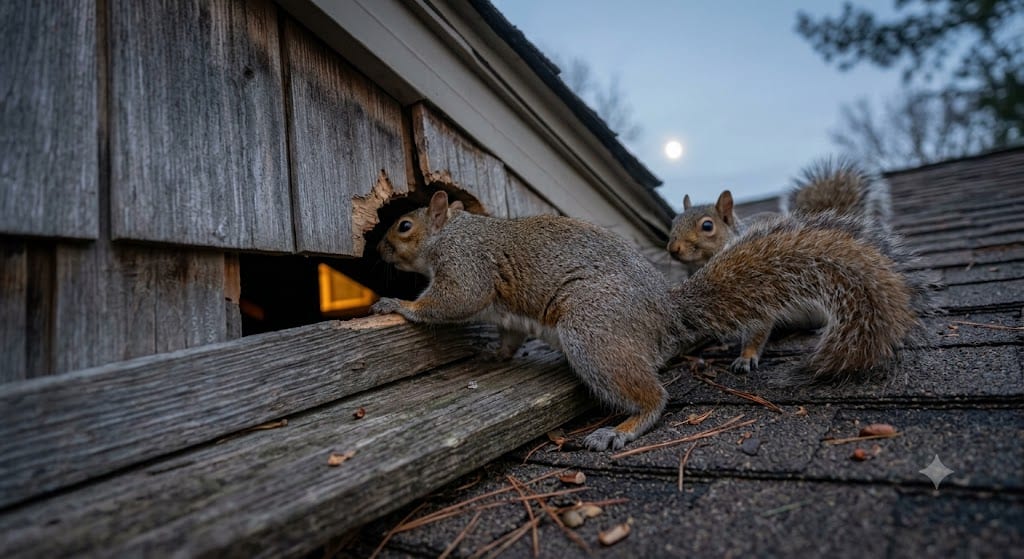
The attic culprits are almost always the gray squirrel and the flying squirrel. Gray squirrels get in through the roofline, gable vents, and gaps where the soffit meets the roof, and because they raise two litters a year in Ohio, once in late winter and again in late summer, there are very often young in the nest when you find them.
Flying squirrels are the sneaky ones. They are small enough to use openings other squirrels cannot, they are active at night so you hear them after dark, and they are social, which means they den in groups. A flying-squirrel problem is rarely one animal; it is usually a small colony sharing your attic, which is why they can be easy to underestimate.
Why a squirrel in the attic is a problem
Squirrels are rodents, and rodents gnaw constantly to keep their front teeth in check. In an attic that instinct goes to work on whatever is there, and the dangerous part is the wiring: a squirrel that strips the insulation off electrical lines is a genuine fire risk. On top of that they shred insulation for nesting, chew structural wood, and leave droppings behind. It is not a problem that gets better on its own.
One useful tell while you are figuring out what you have: squirrels are active in the daytime. Mice and most other attic invaders are quiet during the day and busy at night, so daytime scampering and rolling sounds overhead usually point to squirrels, with the after-dark version pointing to flying squirrels.
Getting them out: exclusion, not just trapping
The lasting fix for squirrels is exclusion, which means finding every way in and closing it, not just catching the animals you can see. The usual approach is to confirm whether there are young, use a one-way door that lets the adults leave but not get back in (and wait until any young are mobile enough to leave with them), and then seal the openings with chew-resistant material so they cannot simply gnaw a new way in. Trapping alone, with the holes left open, just makes room for the next squirrel.
Squirrels are also regulated wildlife in Ohio, with rules about how they can be trapped and moved, so a licensed operator is the clean way to keep the whole thing legal as well as effective.
What squirrel removal costs
The honest answer is that it depends, and it depends on a few specific things: how many ways in there are, whether there are young in the nest, whether you are dealing with a single gray squirrel or a colony of flying squirrels, how much sealing and repair the roofline needs, and how much cleanup the attic takes after. A single entry point with no young is a much smaller job than a flying-squirrel colony plus chewed wiring and soiled insulation.
What you should expect from anyone you hire is the same shape regardless of the number: they inspect and quote before they start, they get the animals out with exclusion rather than trapping alone, and they seal the roofline so the fix holds. That is where professional squirrel removal earns its keep, because the sealing is the part that actually keeps it from happening again.
Keeping squirrels off the roof in the first place
Squirrels get onto a roof the same way every time, by jumping from a nearby branch or climbing a wall, so the most effective thing you can do is give them nothing to jump from. Trim tree limbs back several feet clear of the roofline, because a squirrel can make a surprising leap. Cap the chimney, screen the gable and soffit vents, and keep an eye on the roofline for the small gaps that start as a knot hole and end as a chewed-open doorway.
It also helps to move bird feeders well away from the house. A feeder is a reliable meal that keeps squirrels working the area right next to your roof, and the more time they spend there, the more likely one is to find a way in. None of this removes a squirrel already in the attic, but it makes your roof a much harder target for the next one.
When to call
Daytime scampering in the attic, sounds after dark that could be flying squirrels, chewed wires or wood, a squirrel using the roofline or soffit as a door, or droppings in the attic are all reasons to bring someone in. Caudill Pest Control is local to central Ohio and does wildlife work, including the exclusion that makes squirrel removal stick. If something is busy over your head, give us a call and we will find out what it is.